Olga Ast
STRUCTURE OF HOLES *
A
Full WEB VERSION is under construction
What is the STRUCTURE OF SPACE?
As a conceptual artist, I have worked with SPACE as my main medium since the early 1980s. One of the directions my work has taken is the analysis of structural correlation, form-building principles, and 'methods of assembly' of our 'reality'. The art objects I create are apparatuses that allow for meditation and deeper potential understanding and 'experience' of space.
One of the basic building blocks of space that I try to analyze is A HOLE.
A HOLE (a gap, an opening, …) is something we use in many ways at many times.
A HOLE is so designed that it permits us to look into... to pierce into... to get from... and so on.
A HOLE is the point of entry and exit.
A HOLE is the point of contact, junction, and separation.
A HOLE is the place of origin.
A HOLE is one of the principal building blocks of the formal STRUCTURE of SPACE.
A HOLE indicates both structural correlation and form-building principles.
A HOLE is a main
building block of 'methods of assembly' that allows the 'experience' of space.
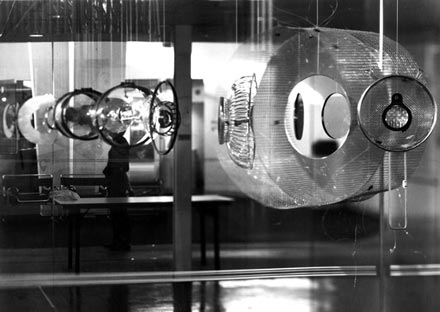
Space-o-Scope
From series 'Space Traps'
Segment 'Structure of Holes'
1986 — current
Mixed Media (mirrors, glass/metal objects, nets, flies, ready-made)
Exhibition in the Art Gallery of Lehman College, New York.
*This is a 'work in progress' that was started in mid 1980s with the 'Structure of Holes' segment started in early 1990s.