|
Contemporary visual space is saturated with synthetic images and their continual reproduction in publications, advertising, television, computer and movie screens. Recently, the invention and expansion of the Internet created yet another image-containing space. Besides being utilized for an array of consumer- and entertainment- oriented purposes, the Internet has involved current fine artists in a multitude of interactive projects that have claimed their place as part of this evolving medium.
In 2000, a group of anonymous artists declared that the production and reproduction of artificial images was visual terrorism occurring on a global scale.
As a necessary extension of their argument, I propose the creation of several Artistic Actions (which could also be called Art Games) that would highlight this current trend. The necessity for such Art Games as a legitimate response to contemporary phenomena lies in their foundation as one of the alternatives of endless image production and still preserves the social function of fine arts. Art Games do not generate novel images or physical objects, but rather work on a semantic level.
I began my work with Art Games in mid 80s, with projects such as Your Soup is in the Fridge and Museum Space Trap. More on these can be found at www.asto.us (a page is under construction)
Dedicated to Sherrie Levine
A piece of art, whether permanent or temporary, must exist in a recognized exhibition space for an unspecified period of time.
An act of theft is classified by the placement of a foreign signature on the art object, or the object¹s photographic capture, by the game participant.
The art object may or may not be recognized as such within the exhibition space.
If the art object is recognized as such, it cannot be stolen without first being subject by a modification by the game participant.
Stolen art may not include arbitrary objects (e.g. a light switch, a gallery floor, a fire extinguisher) without a strong semantic component. See examples from current collection.
If an individual, such as a gallery owner or employee, violates a stolen art object by erasing a signature or removing the said piece, our group will recognize their action as an act of vandalism.
All rules are a subject to change without notification.
This collection is inclusive of any objects originating from a day after an exhibition opening, presentation, or other such event in a space officially recognized as an art space.
The object can be a collection of images.
The object can be a description of any sort.
All rules are a subject to change without notification.
Nonparticipation must be conspicuous.
Nonparticipation must be recognized by at least three persons as an art piece or action of the “Nonparticipating Art Collection.”
Obtaining and demonstrating proof of such action is optional but recommended.
All rules are a subject to change without notification.
This Artistic Action is in development as a contest without a specified deadline.
The title does not assume that image production will cease after the completion of a successful “Last Image.”
The Image¹s measure of success will rest on the probability of at least 60% of its viewers concluding that it is, in fact, the Last Image.
All rules are a subject to change without notification.
Dedicated to Herostratus (sorry fo the cliche)
Objects suitable for submission to this collection:
A visual or verbal description, or an art criticism, of any major destructive event (historical, invented, etc.) that can be interpreted as an artistic action.
A visual or verbal description, or an art criticism, of an already-existing such description or criticism of a major destructive event, e. g. of the film Titanic, of the painting The Last Supper.
The creator of the destructive event is prohibited from introducing his piece to this collection, but may only act as a victim or a passive participant to the event creation.
A fictitious event may not be physically manifest and may not be physically subject to its descriptor.
A fictitious event that has, in fact, been realized in reality, inclusive of natural disasters and those events realized by their descriptors, will lead to automatic disqualification.
The descriptor of any fictitious event must then prevent its realization.
All rules are a subject to change without notification.
This game is not subject to a set of rules. Any kind of active or passive rejection is acceptable.
There is a contest for submission of personal and temporary sets of game rules.
All rules are a subject to change without notification.
A
Family Mail Game for families of one or more persons.
Dedicated
to Russian conceptual poet Lev Rubinshtein
When I was a little girl I faced the most "fundamental" and the oddest property of this world.
If a person wishes to concentrate on the current moment of time, he or she will never be able to do this. The current moment cannot be caught. It passes this very instant. One cannot catch, nor stop, nor prolong the present moment. Past is always there (the moment which has just passed), and so is Future (the moment which is about to come), but there exists no Present. Therefore, our reality does not exist, either, as it is impossible to catch every separate moment of its existence. I believe this to be a lucid demonstration of the temporary nature of our temporal world.
There's a paradox: Future and Past seem more REAL categories than Present in a contrary of so called "common sense."
It means
that we are existent, too: we do not exist, for who can catch the present moment
of our life by the tail. It is gone again! And again! And again! But we were
here! And we shall be there for some time to come! And we wish to leave as many
traces of our presence as possible! We want to be remembered! Even if we have
left and banged the door behind us and never looked back!
Family Mail collects the whole range of human relationship in all its diversity.
This is brought together - and afterwards thrown away, back into space.
And if it were our choice we would have scattered the whole world with these notes - impressions of our activity!
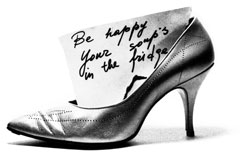
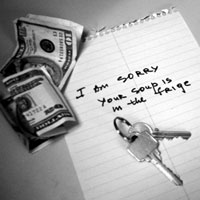
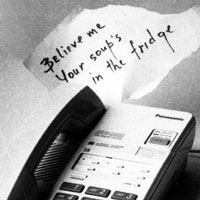
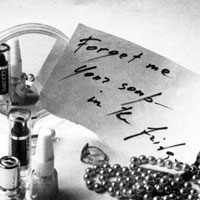
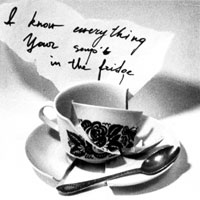
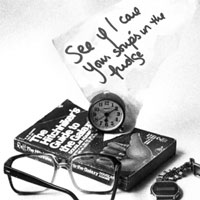
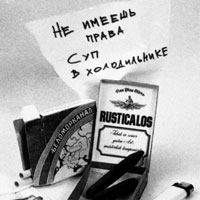
Your Soup's in The Fridge is a poem of emotions, a poem of love. While in Lev Rubinstein's texts one of the major elements is the interval, the entr'acte between cards, or a consequence of phrases, in this poem of mine the main thing is the prolonged gap between two phrases and the location of each message (while the order of reading is different every time). The distances between notes are the animate threads, which entangle you and draw you into the thick and sticky space of marriage.
It is such a composition of pieces of life that the game Your Soup's in The Fridge is made of.
Anyone can play the game:
Write several messages.
Place them in key places of your apartment (near the switch, over the stove, in the fridge, etc.
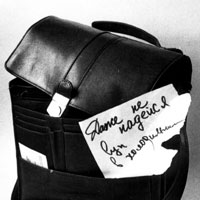
Think up new messages all the time, and find new places to put them in: inside books, in the furniture, in the dishes, among foodstuffs, in your. friends handbags, in stores, in public transportation, etc.
Messages should be unpunctuated, short, imperative,
impersonal (gender less). The text absolutely must have the words Your
Soup's in The Fridge at the end, e.g.,
Come back.
Your
Soup's in The Fridge.
Feel at home.
Your
Soup's in The Fridge.
Forgive me.
Your
Soup's in The Fridge.
All rules are NOT a subject to change without
notification.
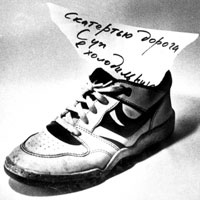
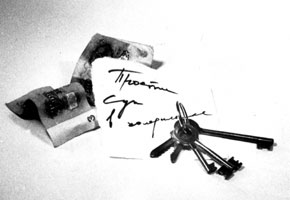 * The Full WEB VERSION
is under construction.
* The Full WEB VERSION
is under construction.
In the installation Museum Space Trap I exhibit not a
particular art object but the moment at which any particular viewer enters.
This installation depends entirely on the specific location in which it is exhibited
- for example the room where all of you are now located.
Under all the objects which are present in such a room,
including the people, metal labels with the object's name, brief description,
and date are placed; the approximate date for last several years has been the
«Beginning of the 21st century.»
There are permanent and temporary exhibited objects in this museum. The former
are things such as «Air», «Scent», «Horizon»
and others, and the latter are, for example, «Walking woman», «Table»,
«Wall», «Glance," etc.
I leave aside the question of who could actually be interested in collecting items from such a museum. I look at the moment that, in this endless installation, we are able to feel as if the instant in which we are located there is a truly historical moment. And in-between these words, in-between these lines, our imagination becomes an endless sculpture in its own right, with a size up to our universe.
Nobody may suggest any gifts and any other items of any kind because all things, which exist in this world, are already listed in this collection.
All rules are NOT a subject to change without notification.











* The Full WEB VERSION is under construction.
*
Most items
from "Stolen Art Collection" may not be reviled because of security
reasons.
"It's
Not Exit" Full size view and Fragment.
Mixed Media.
Stolen on March 9, 2003 at
EXIT BIENNIAL: Reconstruction
Exhibited at EXIT ART, 475 10th Ave, New York, NY
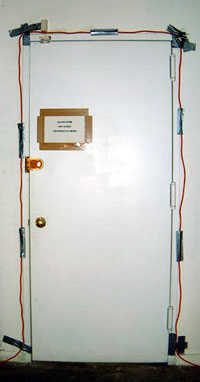
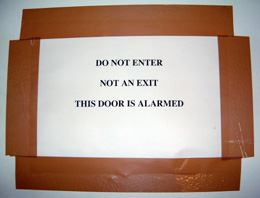
* Photography were taken with a staff member permission.
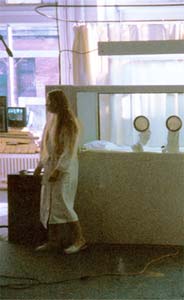
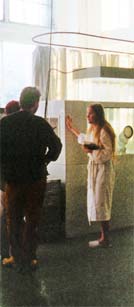
"Next
Day at Exit Art. March 9, 2003" Fragments.
Mixed Media.
March 9, 2003 at
EXIT BIENNIAL: Reconstruction
EXIT ART Gallery, 475 10th Ave, New York, NY
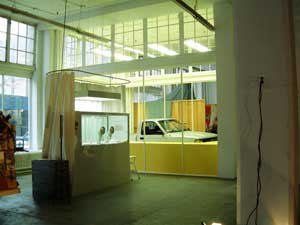
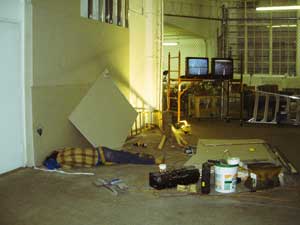
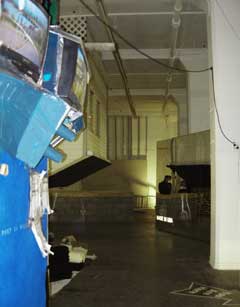
* WEB VERSION is under construction.
* WEB VERSION is under construction.
* WEB VERSION is under construction.
* WEB VERSION is under construction.